
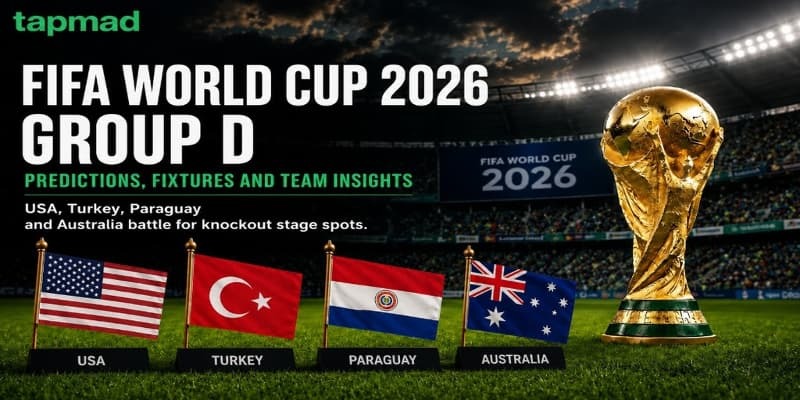
The dynamics of Group D for the 2026 World Cup are generating considerable interest due to the remarkably close FIFA rankings of the participating nations: the United States, Paraguay, Australia, and Turkey. This parity in team strength makes forecasting the group’s progression a significantly more complex task than in many other World Cup scenarios.
- Overview of Group D at the 2026 World Cup
- Host Stadiums
- Tournament Schedule
- Odds and Qualification Chances in Group D
- Tactical Analysis of the Four Teams in Group D
- United States: High Pressing and Home Advantage
- Tactical System
- Strengths
- Weaknesses
- Turkey: Creativity from a Talented Attacking Trio
- Tactical Structure
- Strengths
- Weaknesses
- Paraguay: Defensive Discipline and Tactical Structure
- Tactical Approach
- Strengths
- Weaknesses
- Australia: Counterattacking Structure and Strong Physicality
- Key Players Who Could Decide the Group
- Important Matches in Group D
- United States vs Paraguay
- United States vs Turkey
- Three Possible Scenarios in Group D
- Scenario 1 (Most Likely)
- Scenario 2
- Scenario 3 (Surprise Outcome)
- Conclusion
Overview of Group D at the 2026 World Cup
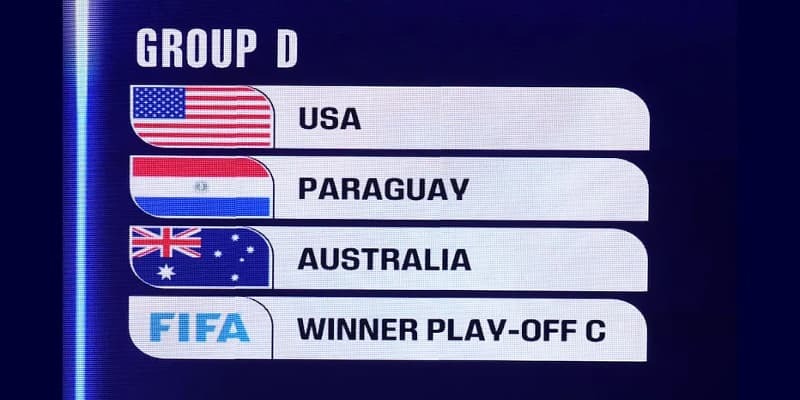
Group D is widely recognized as one of the tournament’s most unpredictable sections. All four teams fall within a narrow FIFA ranking range of 16th to 40th, resulting in minimal disparities in overall quality.
Host Stadiums
Matches in Group D are scheduled to be held at several prominent venues across North America:
- SoFi Stadium – Los Angeles
- BC Place – Vancouver
- Lumen Field – Seattle
- Levi’s Stadium – The Iconic Heart of the San Francisco Bay Area
Tournament Schedule
The Group D fixtures are set to take place from June 12 to June 25, 2026. This 14-day period provides teams with a slightly longer interval between matches compared to some other groups, allowing for enhanced recovery and preparation.
Odds and Qualification Chances in Group D
Predictive models suggest a relatively even distribution of qualification probabilities within Group D. However, the United States and Turkey are still perceived as having a slight edge over their counterparts.
| Team | Chance to finish 1st | Chance to finish 2nd | Overall qualification chance |
|---|---|---|---|
| United States | 41% | 41% | 82% |
| Turkey | 37% | 43% | 80% |
| Paraguay | 17% | 49% | 66% |
| Australia | 10% | 30% | 40% |
A noteworthy observation is that Group D stands out as one of the few in the tournament where two teams possess an over 80% likelihood of advancing. This underscores the intense competition anticipated between the United States and Turkey. Meanwhile, Paraguay retains a solid chance of progressing, bolstered by the expanded 48-team format that offers a pathway for top third-placed teams to reach the knockout stages.
Tactical Analysis of the Four Teams in Group D
A compelling aspect of predicting Group D’s trajectory in the 2026 World Cup is the diverse footballing philosophies represented by each team, promising captivating tactical duels in every fixture.
United States: High Pressing and Home Advantage
As co-hosts, the United States carries significant expectations into the 2026 World Cup. Under head coach Mauricio Pochettino, the American squad emphasizes a high-pressing game and rapid wing play.
Tactical System
The team typically employs:
- 4-3-3
- 4-2-3-1
Key players include:
- Christian Pulisic
- Weston McKennie
- Tyler Adams
Strengths
- Significant home advantage, with all matches on the West Coast.
- A youthful squad composed of players competing in major European leagues.
- A highly experienced coach in international competitions.
Weaknesses
- Defensive vulnerability.
- The pressure of meeting elevated expectations.
- Some key players nearing the latter stages of their careers.
Recent friendly results, including heavy defeats to Belgium and Portugal, have also raised concerns.
Turkey: Creativity from a Talented Attacking Trio
Following a 24-year absence, Turkey makes a return to the World Cup with a promising generation of young talent. Head coach Vincenzo Montella has centered the team around three creative playmakers:
- Arda Güler
- Kenan Yıldız
- Hakan Çalhanoğlu
Tactical Structure
Turkey generally adopts a 4-2-3-1 formation, with Çalhanoğlu dictating the midfield tempo.
Strengths
- Creative and technically gifted attacking players.
- An energetic young squad.
- High motivation following their World Cup qualification.
Weaknesses
- Inconsistent defensive organization.
- Variability in finishing.
- A pronounced reliance on Güler’s creative output.
Turkey’s performance at Euro 2024, where they reached the quarterfinals, impressed many observers.
Paraguay: Defensive Discipline and Tactical Structure
Paraguay is renowned for its disciplined defensive approach, a philosophy that head coach Gustavo Alfaro has continued to cultivate.
Tactical Approach
Paraguay typically plays with:
- 4-3-3
- 5-3-2
The team’s strategy emphasizes:
- A deep defensive block.
- Rapid counterattacks.
- Effectiveness from set pieces.
Strengths
- Strong tactical discipline.
- Excellent aerial prowess.
- High team morale.
Weaknesses
- Limited goal-scoring efficiency.
- Absence of a prolific striker.
- A defensive style that can sometimes invite pressure.
Despite these challenges, Paraguay is still regarded as a potential dark horse in Group D predictions.
Australia: Counterattacking Structure and Strong Physicality
Australia boasts one of the longest continuous World Cup participation streaks among teams in its confederation. Head coach Tony Popovic has introduced a slightly more attacking dimension to the team’s play.
Tactical system: Australia typically utilizes a 4-3-3 formation, with a focus on swift counterattacks.
Strengths:
- Strong physical conditioning.
- A determined fighting spirit.
- Experience gained from recent World Cup campaigns.
Weaknesses:
- A lack of globally recognized star players.
- Limited squad depth.
- Inconsistent ball possession.
Australia’s primary objective is realistically to secure third place and contend for a spot among the best third-placed teams advancing to the next round.
Key Players Who Could Decide the Group
In a group as evenly matched as this, individual brilliance can be the deciding factor. Four players expected to have a significant impact include:
- Christian Pulisic – The United States’ attacking engine, known for his creativity and speed.
- Arda Güler – One of Turkey’s most promising young midfield talents.
- Miguel Almirón – A dynamic playmaker recognized for his energy and ability to facilitate quick transitions.
- Mathew Leckie – An experienced winger who brings pace and versatility to Australia’s forward line.
Any absence of these key players due to injury could substantially alter the predicted outcomes for Group D at the 2026 World Cup.
Important Matches in Group D
Group D comprises six matches in total, with several encounters holding the potential to significantly influence the final standings.
United States vs Paraguay
This is the opening fixture of the group. A victory for the United States would provide a substantial boost in the race for first place. Conversely, an upset by Paraguay could quickly make the group highly unpredictable.
United States vs Turkey
Scheduled for June 25 at SoFi Stadium, this match is widely considered the pivotal encounter for determining the group winner. Many analytical models suggest a 1-1 draw as a highly probable outcome.

Three Possible Scenarios in Group D
Based on team strengths and recent performances, three primary scenarios emerge when predicting the dynamics of Group D at the 2026 World Cup.
Scenario 1 (Most Likely)
- United States finishes first.
- Turkey finishes second.
- Paraguay finishes third but still has a chance to advance.
Scenario 2
- Turkey wins the group.
- United States finishes second.
- Paraguay remains third.
Scenario 3 (Surprise Outcome)
- Paraguay defeats the United States in their opening match.
- Turkey and Paraguay advance, with the United States dropping to third place.
Conclusion
In summary, Group D at the 2026 World Cup is poised to be the most evenly contested in the tournament, with no team holding a clear dominance. The United States benefits from home advantage, Turkey offers potent attacking creativity, Paraguay brings defensive solidity, and Australia relies on its physicality and determination. The closely matched nature of these teams promises an exciting and unpredictable competition.