
By Brian Sommer
Sqairz, a golf and athletic footwear brand, champions a philosophy centered on the natural freedom of the human foot. Their core principle asserts that traditional golf shoes often restrict the foot, forcing it into an unnatural position. In contrast, Sqairz’s innovative design aims to free the toes, allowing them to spread naturally, thus promoting foot stability and, implicitly, enhancing a golfer’s performance.
The company has successfully established itself among professional golfers. Noteworthy wearers include Sepp Straka, and a significant endorsement comes from the highly respected Nick Faldo, whose illustrious career lends considerable credibility to the brand’s claims.
At its core, the brand’s primary assertion revolves around enhanced stability, coupled with superior traction, all purportedly leveraging “ground forces.” This concept, often presented with an almost mystical aura, suggests a secret to the golf swing derived from energy channeled through the footwear. While the existence of ground forces is undeniable, the extent to which a shoe can genuinely amplify them to significantly improve competitive performance remains a subject of skepticism.
This brings us to a recurring question: if this footwear is truly groundbreaking, why isn’t it universally adopted? Why aren’t golfers, regardless of their endorsements, rushing to embrace it? The persistent gap between marketing claims and tangible results provides the answer. The golf industry often operates on the principle that the newest product is essential, rendering its immediate predecessor obsolete, regardless of its actual wear or functionality.
For example, claims of increased driving distance are frequently made – distance attributed solely to footwear. One must pause to consider the laws of physics here. Are we to accept that a golfer of Rory McIlroy’s caliber, with his existing equipment, is truly sacrificing yards simply because his outsole isn’t “enlightened” enough? While a pleasant idea, it tends to dissipate rapidly when confronted with the realities of the golf course.
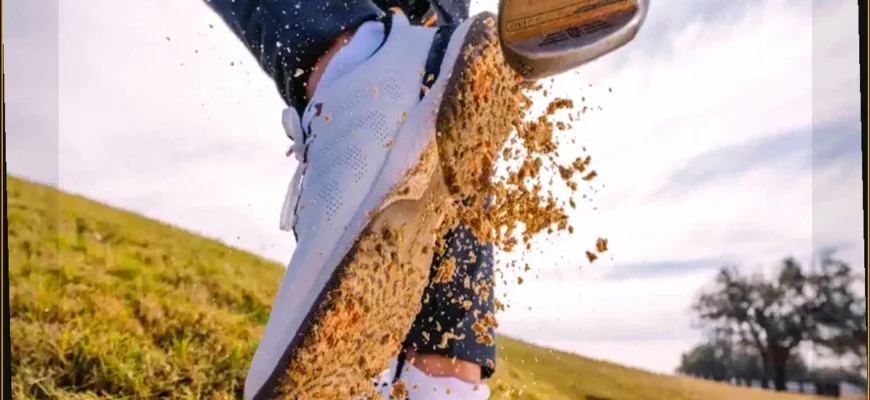
After personally trying the SPEED3 in its striking “solar orange” color – a name that evokes a sense of vibrant power – I can confirm its fundamental nature: it is, indeed, a golf shoe. A commendable one at that, offering comfort, stability, and a refined appearance. Wearing them, one experiences a solid connection to the ground, fulfilling the basic function of any footwear not designed for flight.
Modern golf shoes often represent an amalgamation of ambitious features masquerading as essential engineering. They are expected to be simultaneously lightweight and stable, breathable and waterproof, athletic and stylish. The SPEED3 meticulously addresses these demands. Its microfiber material is antimicrobial and climate-regulating, its reinforcement uses terminology reminiscent of military-grade textiles, and its ventilation is described not as accidental, but “strategic.” Moisture, we are assured, is actively expelled, not merely tolerated.
Even waterproofing is presented with an almost absolute commitment. The fully gusseted tongue creates such an impenetrable seal that it seems almost prepared to ward off rain with diplomatic force. The proudly patented toe box offers each individual toe a degree of freedom typically associated with sovereign entities, all purportedly to facilitate a more effective “engagement with the ground”—a concept that blends technical biomechanics with abstract philosophy.
The shoe also features energy-returning midsoles, high-durometer outsoles, meticulously designed traction systems, and spikes promising exceptional longevity. While this list of features is impressive, the claims accompanying them are rather astounding: an additional twelve yards of distance, nearly four miles per hour added to swing speed, and a thirty percent reduction in shot dispersion. These are not minor improvements; they are truly transformative assertions which, if accurate, would arguably make much of traditional golf instruction redundant.
To reinforce these claims, respected authorities are naturally brought in. Nick Faldo is joined by David Duval and renowned golf instructor David Leadbetter—all figures with unblemished reputations whose involvement serves to lend significant credibility and weight to the product’s marketing.
However, the inconvenient truth—almost subversive in its simplicity—is that the shoe itself is genuinely excellent. It functions precisely as a quality golf shoe should, proving comfortable, stable, and meticulously crafted. In essence, its success stems from its inherent merits, entirely independent of the elaborate marketing narratives woven around it.
This highlights an enduring paradox within the golf industry: products are frequently well-made, even commendable, yet their accompanying marketing narratives often become so inflated they verge on self-parody.
Therefore, the Sqairz SPEED3 isn’t a revolutionary breakthrough. Instead, it’s something far more understated and truthful: a competently engineered golf shoe that is nonetheless marketed as a technological revelation. While it won’t miraculously transform your swing or unlock mystical ground forces, it will undoubtedly provide comfort for your walk and stability for your swing.