
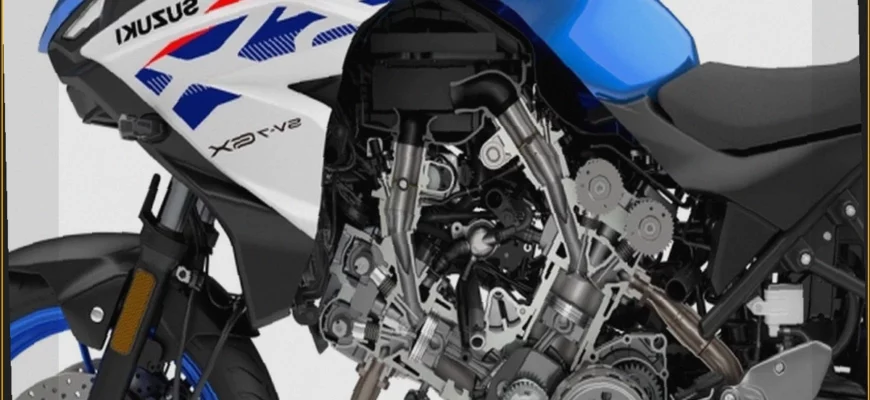
Suzuki is defying expectations by bringing back its renowned 645cc V2 engine, not retiring it. While many anticipated the future of Suzuki’s mid-range models would rely solely on the 776cc parallel twin, Hamamatsu has opted for a different path. The result is the new SV-7GX, a street crossover that inherits the technical legacy of the SV650, updated to compete in today’s more dynamic market. This isn’t just about a new model; it’s a statement about Suzuki’s continued belief in its V-twin – an engine that has become almost an identity statement over the years. It’s compact, smooth, strong in the mid-range, and possesses a unique, irregular beat that sets it apart from modern parallel twins.
First introduced in 1999 with the SV650, this 645cc liquid-cooled, DOHC, 90-degree V-twin engine returns, updated for the SV-7GX, retaining its distinct character. It features an 81 x 62.6 mm bore and stroke, delivering a maximum power of 73 hp at 8,500 rpm and 64 Nm of torque at 6,800 rpm. These figures underscore its philosophy of providing usable, linear, and friendly power rather than aiming for astonishing peak performance.
What’s New: Euro 5+ and Advanced Tech
To meet Euro 5+ regulations and remain competitive in a market demanding more electronics and refined operation, Suzuki has made targeted interventions across the intake, fueling, engine management, and transmission systems. Key updates include ride-by-wire electronic throttle control, downdraft throttle bodies, optimized injectors, dual ignition with iridium spark plugs, a revised airbox, and a re-tuned 2-in-1 exhaust. Internally, the crankshaft has been updated with larger supports, alongside other modifications aimed at increasing robustness and reducing friction.
Further enhancing durability and efficiency, Suzuki has applied internal finishes like SCEM (Suzuki Composite Electrochemical Material) cylinder plating, anti-friction surface treatment on pistons, and specific cross-section rings. This isn’t merely a remapped older engine; it’s a comprehensively updated unit designed to preserve its original character while improving efficiency, throttle response, and compatibility with modern electronics.
The Ride-by-Wire Revolution
The adoption of electronic throttle control is perhaps the most significant advancement, opening the door to features previously absent or minimal in the SV family. The SV-7GX now incorporates the S.I.R.S. (Suzuki Intelligent Ride System), a comprehensive suite of electronic rider aids. This includes three engine maps, three-level traction control (plus off), a bi-directional quickshifter, Easy Start System, and Low RPM Assist. This marks a clear generational leap from the SV650’s simpler setup.
Crucially, this modernization doesn’t strip the V2 of its personality. Engineers have focused on maintaining the V-twin’s robust and direct response, adding only the tools now considered standard in the mid-range segment. Riders will benefit from improved throttle modulation, more refined control on challenging surfaces, and the convenience of clutchless gear changes.
A Versatile Mid-Range Crossover
The new SV-7GX is designed as a practical mid-range crossover for daily commuting, light touring, and extra-urban travel, rather than an off-road machine or a caricatured adventure bike. It features an upright riding position and enhanced aerodynamic protection compared to the SV650. The chassis retains a steel trellis frame, complemented by 17-inch wheels shod with Pirelli Angel GT II tires – a clear indication of its road-oriented design.
Journey Without Excess
Suspension consists of a 41mm telescopic fork and a rear monoshock with progressive linkages, adjustable for preload. The seat height is a manageable 795mm, and the wet weight is 211kg, with a 17.4-liter fuel tank. These specifications highlight a motorcycle designed to be accessible, practical, and unintimidating – more akin to a raised sport tourer than a mini maxi-enduro. The feature set includes a three-position adjustable windscreen, handguards, a 4.2-inch color TFT display, smartphone connectivity, and a USB-C port. Notably absent is cruise control, suggesting Suzuki’s intent to control complexity and pricing while still offering desired modern amenities.
Going Against the Grain
Ultimately, the most significant news isn’t just the arrival of the SV-7GX, but Suzuki’s decision to extend the life of its 645cc V-twin at a time when most competitors are choosing architectures that are easier to industrialize and standardize. Suzuki, however, continues to bet on an engine that isn’t the cheapest or simplest to integrate into a global strategy, but one that still boasts a precise and recognizable technical personality.
This choice resonates with enthusiasts and beyond. The Suzuki V2 hasn’t survived for over a quarter of a century out of pure romanticism; it endures thanks to a rare balance of reliability, ease of riding, manageable running costs, and mechanical pleasure. The SV-7GX now aims to bring these qualities into a contemporary package, appealing to those seeking a versatile and distinctive motorcycle without increasing displacement or succumbing to the “total adventure” trend.