
Devotees of combat sports possess a keen eye, often perceiving nuances that escape casual spectators. Their focus extends beyond mere impacts; they analyze intricate footwork, strategic ring positioning, and the meticulous build-up to an action, valuing the preparation as much as the final execution.
This acute attention to detail is precisely why many combat sports fans eventually gravitate towards an appreciation for Japanese swords. Their interest isn’t rooted in weapon fantasy, but in recognizing the identical core values they cherish in martial arts: precision, absolute control, unparalleled efficiency, and an elegant execution that transforms complexity into effortless simplicity.
This intriguing crossover is more logical than it might initially appear. Let’s delve into how this connection typically unfolds.
- The Allure of Precision: Beyond Raw Impact for Combat Sports Aficionados
- Discipline as a Core Fascination
- The Shared Sensibilities: Bridging Blade Culture and Combat Sports
- Initial Spark from Media, Enduring Fascination through Craftsmanship
- Initial Observations for New Collectors from a Combat Sports Background
- From Martial Prowess to Material Artistry: An Evolution of Appreciation
The Allure of Precision: Beyond Raw Impact for Combat Sports Aficionados
The most captivating battles are rarely chaotic; instead, they are characterized by movements meticulously planned and executed, each serving a specific intent. A precisely timed level change, a perfectly placed jab, or a sweep that disrupts an opponent mid-stride – these are moments that highlight supreme control under duress.
This profound appreciation for technical mastery transcends the arena of combat sports. It naturally extends to any domain embodying similar principles. A masterfully crafted katana, for instance, is an artifact where every single dimension is purpose-driven.
The blade’s subtle curvature dictates its cutting dynamics. The hilt’s length influences available grip variations. The sword’s balance and weight distribution govern its fluid movement during a swing.
Consequently, it’s common for some fight fans to meticulously analyze descriptions of katanas, applying the same discerning eye they use to dissect a fighter’s technique. Their purchasing isn’t impulsive; it’s a careful study of how each design element contributes to the overall function and efficacy.
This transition feels entirely natural because the underlying thought process is identical. When observing a fight, one asks: “Why was that effective?” When examining a sword, the same fundamental question arises.
Discipline as a Core Fascination
In the realm of combat sports, the most revered athletes are seldom the most erratic. Instead, they are individuals who maintain unwavering composure when confronted with immense pressure.
Figures like Georges St-Pierre masterfully dictated distance, preventing opponents from establishing their rhythm. Anderson Silva famously waited in the pocket, hands low, expertly reading reactions before engaging. Demetrious Johnson exhibited a relentless consistency that left even elite adversaries appearing ill-prepared.
The common thread among these fighters is profound discipline – extending beyond mere physical conditioning to encompass the capacity to execute the correct action at the opportune moment, conserving energy by eliminating superfluous movements.
This intrinsic connection to the discipline and precision epitomized by Japanese blades is often what draws martial arts enthusiasts to a specialized samurai sword outlet. Here, they can examine authentic examples and witness firsthand how such a high level of craftsmanship manifests in a tangible object.
A katana is not engineered for versatility in every conceivable scenario. It is meticulously designed for particular cutting techniques, intended for a specific grip, and requires a precise maintenance regimen. This singular focus resonates deeply with those who already comprehend that true mastery is forged through dedicated specialization, rather than through diluted generalization.
The Shared Sensibilities: Bridging Blade Culture and Combat Sports
Combat sports enthusiasts and sword aficionados share more commonalities than either group might initially realize.
Both communities exhibit a meticulous focus on the intricacies of their respective equipment. MMA fans might passionately discuss glove brands, shin guard thickness, or mouthpiece fit, while sword enthusiasts delve into steel types, handle wrapping techniques, and tsuba (guard) designs. Though the topics differ, the underlying analytical behavior is identical: assessing gear based on its functional performance and construction quality, not merely its aesthetic appeal.
Furthermore, both groups deeply value the economy of motion. A flamboyant, missed spinning kick garners significantly less respect than a precise, landed straight punch. Likewise, a sword adorned with elaborate embellishments but possessing poor balance holds less esteem among serious collectors than a simpler blade with impeccable proportions.
Crucially, both communities are driven to understand the rationale underpinning technique. Why does a fighter initiate a takedown with a jab? What is the functional purpose behind a blade’s specific curvature? Those who remain truly engaged are the ones eager to grasp the underlying logic, rather than simply admiring the outcome.
Initial Spark from Media, Enduring Fascination through Craftsmanship
The initial gateway into this interest often varies. For some fight fans, it might be ignited by cinematic portrayals, such as the sword fighting in “Kill Bill” or “John Wick.” Others might find their introduction through video games like “Ghost of Tsushima” or “Sekiro.” A segment might even stumble upon it via social media, observing MMA fighters who maintain personal blade collections.
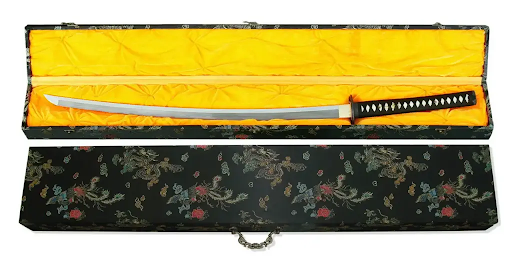
Irrespective of the genesis, the subsequent trajectory generally remains consistent. The initial allure is primarily visual; a sword’s striking presence is sufficient to capture attention.
However, what sustains and deepens this engagement is the profound craftsmanship underlying its aesthetic. Discovering, for instance, that the distinctive wavy line (hamon) on a blade results from a sophisticated differential heat treatment, rather than being painted on. Appreciating how the intricate pattern of the handle wrapping simultaneously influences grip security and visual appeal.
Perceiving that a meticulously proportioned sword exudes a visual equilibrium conspicuously absent in a poorly constructed one, even from a distance.
This trajectory closely parallels the journey of a combat sports fan, evolving from admiring highlight reels to delving into comprehensive training camps and strategic corner advice. The superficial draws you in; the inherent substance compels you to stay.
Initial Observations for New Collectors from a Combat Sports Background
Individuals transitioning from a combat sports background often prioritize distinct characteristics when initially examining swords, differing from general collectors.
The blade’s curvature is frequently the first feature to command their attention. Every sword exhibits a unique arc, and this variance is far from merely aesthetic. A pronounced curve alters how the blade interacts with a target during a draw cut, whereas a straighter profile is more conducive to thrusting. Recognizing these subtle distinctions marks the initial step in perceiving swords as specialized tools.
Following this, the handle wrapping (ito) becomes a focal point. The specific pattern and tension of the cord on the grip are both practical and ornamental. A taut, uniform wrap ensures a firm, secure hold, while loose or irregular wrapping indicates a lack of meticulous craftsmanship.
The guard, or tsuba, often captures interest due to its extensive design diversity. Some are unadorned iron discs, while others showcase intricate scenes cast from bronze or copper alloys.
The fit of the scabbard (saya) is a detail often overlooked by many until they witness a superior example. A perfectly fitted saya secures the blade with precisely enough friction to prevent rattling, yet allows for a smooth, effortless release with a gentle thumb push against the guard.
From Martial Prowess to Material Artistry: An Evolution of Appreciation
For many combat sports enthusiasts who cultivate an interest in Japanese swords, the motivation isn’t to acquire a mere weapon. Instead, they seek an artifact that embodies the principles and values they already deeply cherish.
This impulse mirrors the desire that drives individuals to collect high-end watches, bespoke tools, or handcrafted leather goods. The appeal isn’t primarily about practical utility, but rather the profound appreciation for the masterful artistry and meticulous effort invested in creating something of exceptional quality. Comprehending the deliberate choices in materials, the intricate assembly process, and the refined finishing provides a deep satisfaction in itself.
For devotees of combat sports, this satisfaction carries an additional layer of resonance. The inherent discipline, precise engineering, and efficient design evident in a finely crafted blade directly echo the very qualities they admire in their most respected fighters. The object connects with them profoundly because it articulates a philosophy they inherently grasp.
Therefore, the journey of combat sports fans towards an interest in katana swords is not a mere coincidence. It is a logical progression, driven by the identical discerning eye for precision and controlled execution that first drew them to impeccable performances in the arena, now leading them to blades where every minute detail serves a deliberate, purposeful reason.