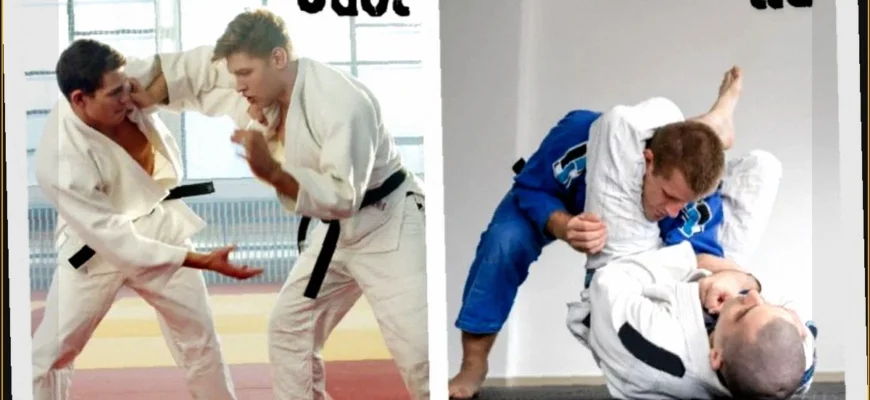
While both Judo and Jiu-Jitsu share a common ancestry, originate from similar uniforms, and are practiced on a mat, they are far from being the same sport. These are distinct disciplines, each with its own philosophy, set of rules, and approach to victory.
Let’s delve into the specifics.
What is Judo?
At its core, Judo is a martial art focused on powerfully and controlledly bringing an opponent to the ground. A decisive throw, known as an ‘Ippon,’ immediately ends the match. There are no second chances or points accumulation; the contest is over.
Founded by Jigoro Kano in 1882, Judo evolved from traditional Jujutsu schools into a more formalized sport. It became an Olympic sport in 1964 and has since seen its governing body, the International Judo Federation, oversee the sport in over 200 member countries.
Judo’s scoring system comprises three levels:
- Ippon: An instant win achieved through a throw, a 20-second pin, or a submission.
- Waza-ari: A half-point, with two Waza-ari equaling an Ippon.
- Shido: A penalty awarded for passivity or rule infringements.
Matches for senior men typically last 4 minutes. In the event of a tie, a sudden-death overtime period with no time limit can ensue, potentially leading to significant outcomes. The 2025 World Championships in Budapest saw 556 referees from 93 nations participate, with Georgia claiming its first Mixed Team World title. Past Olympic games have demonstrated the extent to which global competition has advanced beyond the traditional confines of Judo.
Jiu-Jitsu: A Different Approach to Problem-Solving
Brazilian Jiu-Jitsu (BJJ) incorporated elements of ground fighting that were less emphasized in Judo, developing into its own distinct sport.
The lineage of Jiu-Jitsu traces back to Brazil in the early 20th century. Its roots lie in the late 19th century when Mitsuie Maeda, a Judo master trained at the Kodokan in Japan, emigrated and imparted his skills to Carlos Gracie.
The International Jiu-Jitsu Federation (JJIF) organizes Jiu-Jitsu competitions, and their scoring system reflects a strategy-centric philosophy:
- Takedown: 2 points
- Guard Pass: 3 points
- Mount or Back Control: 4 points
- Submission: Immediate win
Submissions in Jiu-Jitsu result in an instant victory. Matches are longer than in Judo, lasting 5 to 10 minutes depending on the belt level. The pace is generally slower and more deliberate, focusing on strategic positioning and waiting for the opportune moment.
What Differentiates These Two Sports?
The crux of the debate between Judo and Jiu-Jitsu often centers on one question: where does the fight primarily take place?
Judo emphasizes standing combat. Throws like Uchi Mata, Seoi Nage, and Harai Goshi are among the most technically sophisticated takedowns across all combat disciplines. The world’s top Judokas can shift momentum in less than a second, taking an opponent to the ground before they even realize what has happened.
If a throw doesn’t result in an Ippon, the referee’s logic shifts. It takes approximately 10-15 seconds for a pin to be fully secured. If no decisive action occurs, the referee stands the competitors up. Prolonged stalemates on the ground are penalized, as the sport actively discourages extended ground exchanges.
Jiu-Jitsu operates on the opposite principle. A practitioner on their back, controlling an opponent with their legs, is considered to be in a dominant position rather than a defensive one. From this vantage point, an experienced grappler seeks submissions like armbars, chokes, and leg locks. The ground game is paramount.
This fundamental difference explains why BJJ is so prevalent in Mixed Martial Arts (MMA). Judo excels at resolving standing engagements and transitioning to the ground. Jiu-Jitsu, conversely, focuses on what to do once you are on the ground.
President’s Cup: Competitions for All Levels
The U.S. President’s Cup in Judo stands as one of the most significant national tournaments on the calendar. The 2025 U.S. President’s Cup is scheduled to take place over 23 days in November in Irving, Texas, offering qualifying opportunities for Senior Level C, Junior Level 3, veterans, and visually impaired athletes.
What makes the President’s Cup noteworthy is its inclusivity. It’s not solely a showcase for elite senior athletes but also a platform for juniors, veterans, and visually impaired competitors. This broad reach is uncommon in Judo competitions and points to a more robust developmental ecosystem than typically found.
The 2026 President’s Cup is slated for November 22nd. The November Olympics in Irving are held at the same venue on the same date, providing a final qualification opportunity before the year’s end.
Deep Dive into Technique: Standing vs. Ground Game
The technical disparities between these sports warrant detailed examination, as they explain why athletes transitioning between them require years of adaptation.
Executing a successful throw in Judo demands a precise off-balancing maneuver. Without it, even the most technically sound technique will fail. This emphasis on biomechanics makes Judo principles highly transferable to combat sports and MMA, as strategic advantages can be gained that brute force cannot overcome.
Jiu-Jitsu’s ground hierarchy is structured differently. Position is determined before submission attempts – one must establish control before initiating offensive grappling. The typical sequence involves controlling the opponent or securing guard, followed by a transition to a dominant position.
A defensive maneuver against an experienced Jiu-Jitsu player could result in five minutes of sustained technical pressure. In Judo, such a scenario would likely lead to a stand-up by the referee within three minutes.
The State of Competition Today
Judo’s Olympic status contributes to its structured global circuit. The Judo World Tour spans five continents, featuring Grand Prix and Masters tournaments, alongside direct Olympic qualification events. The 2025 season included the World Championships for adults in Paris, with a record 2316 participants from 64 countries, as well as cadet and junior world championships held in Bulgaria and Peru. The breadth of developmental opportunities is truly impressive.
The official results entry system on the IJF website features a “No-Gi” track, attracting athletes who have never competed in a Gi, indicating the sport’s evolving landscape.
For fans who follow both disciplines throughout the competitive calendar and wish to extend their engagement with combat sports beyond major tournaments, platforms like dbbet offer an outlet for that grappling passion when major events are not live.
Can You Practice Both Disciplines? Should You?
Many serious athletes do pursue both disciplines, and while the transition is feasible, it is a slow process.
Judo practitioners who transition to Jiu-Jitsu often find themselves initially defensive on the ground. They are conditioned to stand. Being on their back is perceived as passive, and adopting a lower position goes against their ingrained instincts. It takes months for them to become comfortable on the ground, a phase that cannot be bypassed.
Conversely, Jiu-Jitsu practitioners often find the standing phase of Judo challenging, as it’s not their primary focus. Grips, footwork, and the explosive pace of takedown entries present a different set of athletic demands. Most Jiu-Jitsu athletes who begin training Judo start with basic groundwork like Osoto Gari or basic hip throws and build from there.