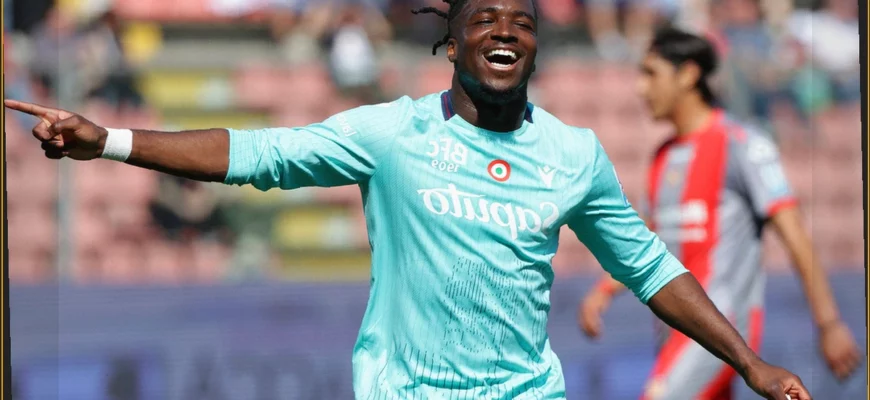
Bologna player Jonathan Rowe has spoken about the incident that led to his and Adrien Rabiot’s departure from Marseille last summer. He also detailed the contrasting coaching philosophies of Roberto De Zerbi in Ligue 1 and Vincenzo Italiano in Serie A.
The former England U21 international shared his experiences in an interview, highlighting his successful transition to Italian football. Rowe has been a key player for Bologna this season, contributing significantly to their goal-scoring efforts with 13 goal involvements in 43 appearances across all competitions.
Rowe on Rabiot Fight, De Zerbi Methods and Bologna Adaptation
“I feel like I’ve settled in now. I feel comfortable. It’s not even been a year yet but I’ve started to find my feet,” Rowe stated.
Recalling the incident at Marseille, Rowe described a heated dressing-room confrontation involving several teammates and staff members, which ultimately resulted in his and Rabiot’s exit. Reports suggest the altercation began with an argument between Rowe and goalkeeper Guillermo Rulli, which Rabiot then joined, leading to the intervention of security personnel.
“It got heated. It was something he said,” Rowe recollected. “The thing is, De Zerbi and Mehdi (Benatia), the (sporting) director, did not see the first punch (Rabiot) threw right at the start. They only saw me come back and hit him. So they probably thought I just hit him out of nowhere. I kind of had to explain it after.”
“Emotions were flaring. Things got out of control. These things happen a lot in changing rooms, more than people probably realise.”
Despite the circumstances of his departure from Marseille, Rowe acknowledged the valuable lessons learned under Roberto De Zerbi’s guidance. “With De Zerbi, I realised you have got to pay more attention to the details. From your first touch to the next pass, to when the ball is on the other side of the pitch. It’s like when you’re driving. You have got to be three steps ahead just in case something happens and you have to be ready to make an intelligent decision.”
He further explained De Zerbi’s demanding training approach: “Sometimes in training I could get a bit bored because of the build-up that we’d be doing would mainly be focused on the defences and the midfielders in order to get the ball to us attackers. You’d be standing around in the hot sun for a few hours. But in a way that trains your brain to stay focused no matter what’s going on in the game. You might see the ball once every 10 or 15 minutes but when you get that ball you have to be decisive or you have to make something happen and create.”
Rowe also shared his surprise at some of De Zerbi’s unconventional team-building exercises. “I’d never done this before. I didn’t even know this was allowed in football. We went into the middle of nowhere, in the woods, in the cold. We’d wake up at 4 am. We’d go to do some run or we’d walk into the woods. Then we’d do push-ups, a little core circuit with the flashlights out in the pitch black then another walk. Then we’d do hill sprints. You know, the fireworks, the pyro; whatever you call it that the fans use in the stadiums. He’d rip one of them open and start walking like we’re Vikings.”
Transitioning to Bologna has facilitated Rowe’s continued development. “It suits my game play,” Rowe said. “When it’s right, when it pays off; winning the ball high up the field, pressing, counter-attacking, being direct. I feel that sums up my game. When it pays off and the rest of the team is on the same wavelength, it almost feels unstoppable.”
He noted the significant shift in playing style from Marseille under De Zerbi, which focused on possession and intricate build-up play. “It was a bit of big shift from Marseille with De Zerbi; keeping possession and trying to find an opening, the little gap between the pockets. It was a change of mindset, because when I came I was trying probably to link up with the players, doing short passes. They were playing long. And I was like: ‘What are you doing?’ They were like: ‘This is how we play?’ It was a bit weird.
“But as time goes on naturally you build those connections, you build more relationships with teammates. You start to understand their strengths and they start to understand yours a lot more. You have to adapt and I’m pretty good at that.”